Linda Osborne Oral History
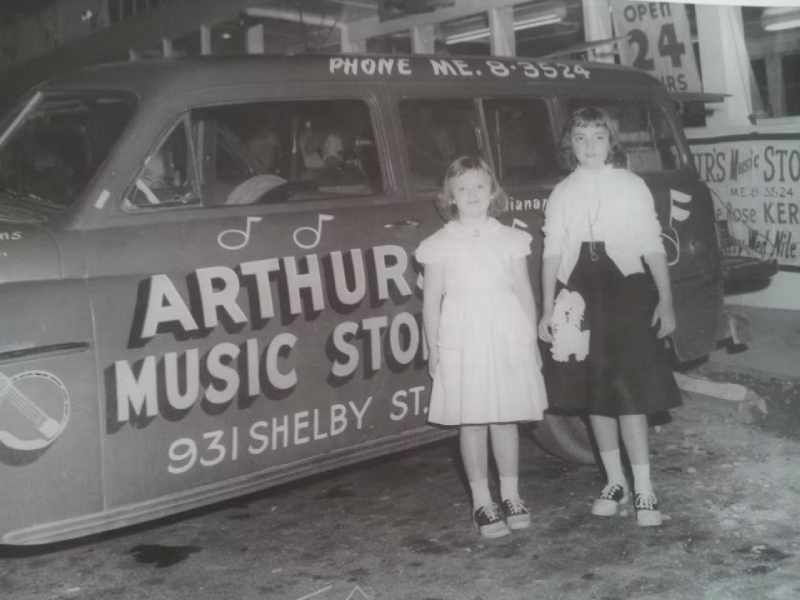
Linda Osborne grew up in Arthur’s Music Store, the Indianapolis family business her parents, Amos and Leola Arthur, opened in 1952. From learning instrument repair as a child to helping run the family’s stores, she built a life in music retail rooted in practical knowledge, personal service, and a love of musical instruments.
In her Indiana Music History Project oral history, recorded with Jeff Gardner on September 10, 2025, Osborne shares memories of the store’s beginnings on Shelby Street, its connections with generations of musicians, and the people behind a business where selling an instrument was only part of the job.
Interview Highlight
In this Interview Highlight, Linda Osborne recalls how her parents, Amos and Leola Arthur, opened Arthur’s Music Store in 1952 and built a family business around instruments, lessons, repairs, and personal service. She also tells the story of the unusual 1958 Gibson Flying V her father ordered and its remarkable connection with Joe Bonamassa decades later—from the photograph of Amos that Bonamassa used as a screensaver to the guitar’s return visit to Arthur’s.
Complete Interview
In this Complete Interview, Linda Osborne recalls growing up in Arthur’s Music Store, learning to repair clarinets from her father, and helping manage the family’s additional locations while attending Butler University. She shares the story of the 1958 Gibson Flying V later owned by Joe Bonamassa and remembers accompanying her father to deliver Fender amplifiers for the Beatles’ Indianapolis visit, while clarifying that she does not know whether the band used them. She also recalls visits from other musicians and explains how lessons, repairs, and personal relationships have sustained the business. Her account offers a view of Indiana music history from behind the counter, where beginners and touring professionals alike came for instruments, advice, and support.
Biography
Linda Osborne was four years old when her parents opened Arthur’s Music Store at 931 Shelby Street in Indianapolis in 1952. Both were musicians and teachers; in Osborne’s telling, they met when Amos gave Leola mandolin lessons. The store began in the front room of a house, with a plate-glass window replacing the front wall. Over time, the business expanded into neighboring houses connected by additions.
Music and work were part of Osborne’s childhood. She began playing accordion at four, took up lap steel and Hawaiian guitar at seven, and later studied clarinet. Her father, who had also worked as a machinist, taught her clarinet repair when she was eleven. She received her first paycheck at twelve.
Amos handled instrument buying and the musical side of the store, while Leola managed its finances and business affairs. As the family expanded into Speedway and Broad Ripple, Osborne took on greater responsibility. She recalls attending Butler while running the Speedway location and later sharing responsibility for the Broad Ripple store with her sister, Elizabeth. Their parents trusted them to order inventory, serve customers, and make the operation work.
Her influence extended to the people who worked alongside her. In Mike Redmond’s 2006 Indianapolis Monthly profile, “Family Act,” musician and former Arthur’s employee Frank Dean credited Osborne with teaching him the service side of music retail: looking beyond product knowledge to the families and young players who depended on the store.
Read “Family Act” by Mike Redmond, Indianapolis Monthly (2006 PDF), a profile of Linda, her daughter Amy, and the family business.
One of the store’s best-known stories centers on a 1958 Gibson Flying V. Osborne recalls that her father ordered one of the earliest examples, intrigued by its unusual design. The angular guitar attracted attention but was not easy to sell. It appeared in a photograph of Amos wearing a button-up striped sweater, and he also sent it along with a store employee giving a guitar lesson to a woman participating in a pole-sitting promotion on Shelby Street. That outing produced another memorable photograph, with the instructor playing the Flying V from a nearby rooftop.
Decades later, the guitar’s story took an unexpected turn. According to Osborne, blues guitarist Joe Bonamassa had been using the photograph of Amos with the Flying V as his computer screensaver. Shortly after buying the instrument himself, Bonamassa and his manager recognized details that connected it to that very photograph. Bonamassa brought the guitar back to Arthur’s and climbed onto the store’s roof to recreate the rooftop picture. The connection also led to an Epiphone “Amos” model. Osborne remembers demand at Arthur’s being so strong that the store held a lottery to determine who could buy its limited allotment. For the family, the guitar became a link between Amos’s adventurous purchase and a new generation discovering the store.
Read “Vintage Gibson guitar flies back to Indy”, Tim Evans’s 2015 Indianapolis Star story republished on Bonamassa’s website. For Bonamassa’s own account and a demonstration of the instrument, visit his “Famous Amos” article and video lesson in Guitar World.
Osborne also remembers accompanying her father to deliver Fender amplifiers to the Indiana State Fairgrounds for the Beatles’ Indianapolis visit. That visit took place on September 3, 1964. She makes a careful distinction: Arthur’s delivered the equipment at Fender’s request, but she does not claim the band used it onstage.
Famous customers are part of the family’s memories, but Osborne describes a preference for treating visiting performers simply as musicians. In one favorite story, her young granddaughter helped Chris Stapleton try a vintage Gibson ES-335 without knowing who he was. He bought the guitar, adding another generation to the family’s history behind the counter.
Throughout the interview, Osborne emphasizes the work beyond selling guitars: lessons, repairs, and knowledge of instruments ranging from banjos and mandolins to steel guitars and accordions. She recalls reviving accordion repair with an employee after finding her parents’ old repair kit, its materials still usable after many years.
The relationships matter just as much. Osborne remembers blues and jazz musicians telling her how Amos had helped them get the equipment they needed for a weekend engagement, allowing them to pay after the job. Her own example of that spirit is an employee reshaping tiny fingerpicks for a three-year-old player—work with little financial return, but the possibility of helping a new musician keep playing.
Osborne’s advice to anyone entering music retail is to enjoy the work, develop many skills, and be willing to do every part of the job. Her oral history preserves the story of a family business and the everyday care that helps a musical community endure.
Visit Arthur’s Music Store’s official website and explore the store’s history page for more about its musical community and family legacy.
Image Gallery
Explore photographs and memorabilia from the Arthur family and Arthur’s Music Store, including family pictures, views of the store, and materials connected with the 1958 Gibson Flying V. Together, they offer a glimpse of the people, instruments, and places behind Osborne’s memories.
Elizabeth and Linda Arthur beside the Arthur’s Music Store vehicle outside the family’s shop at 931 Shelby Street in Indianapolis, circa 1958.
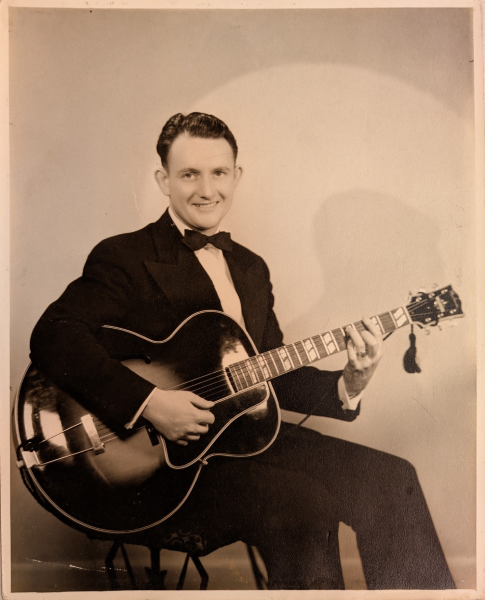
Amos Arthur poses with an archtop guitar, circa 1935, years before he and his wife, Leola, founded Arthur’s Music Store in Indianapolis.
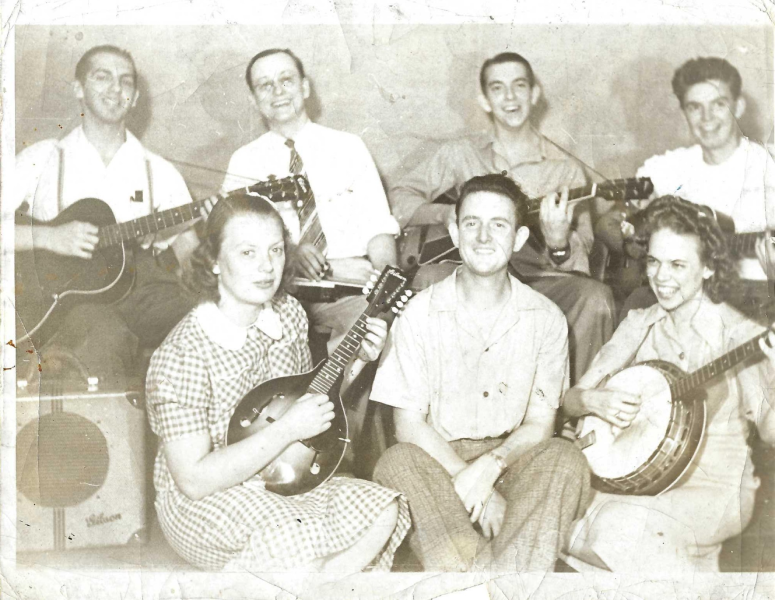
Leola Dill Arthur, holding a mandolin at front left, with Amos Arthur and fellow musicians.

Amos Arthur surrounded by guitars at Arthur’s Music Store in Indianapolis, circa 1954.
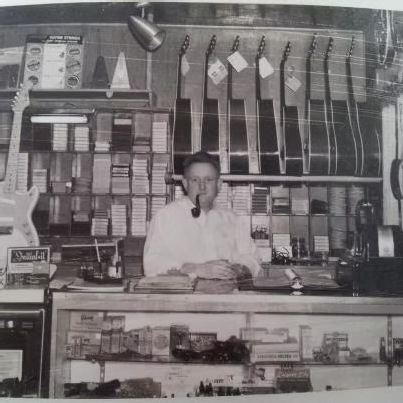
Amos Arthur behind the counter at Arthur’s Music Store in the 1950s, surrounded by instruments, sheet music, and musical accessories.
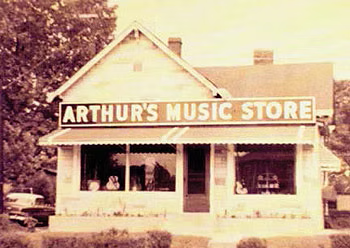
Arthur’s Music Store at 931 Shelby Street in Indianapolis, 1956, four years after Amos and Leola Arthur opened the family business.
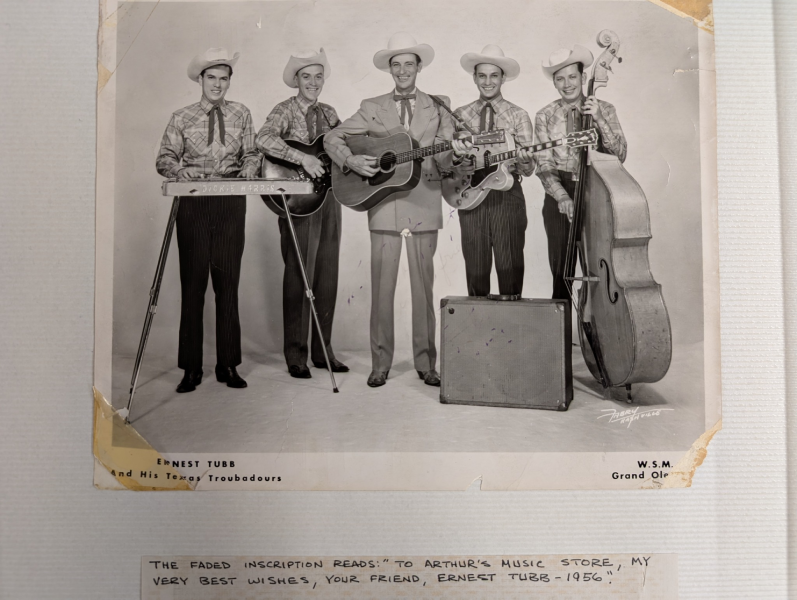
Ernest Tubb and His Texas Troubadours in a publicity photograph inscribed to Arthur’s Music Store, circa 1956. The accompanying note records the faded inscription: “To Arthur’s Music Store, my very best wishes, your friend, Ernest Tubb—1956.”
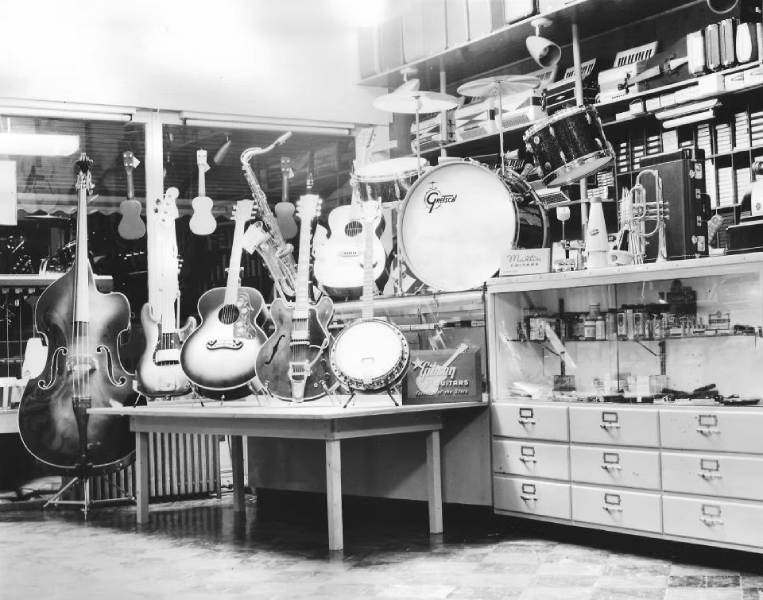
Inside Arthur’s Music Store in 1958, with guitars, an upright bass, a banjo, drums, accordions, and wind instruments filling the displays.
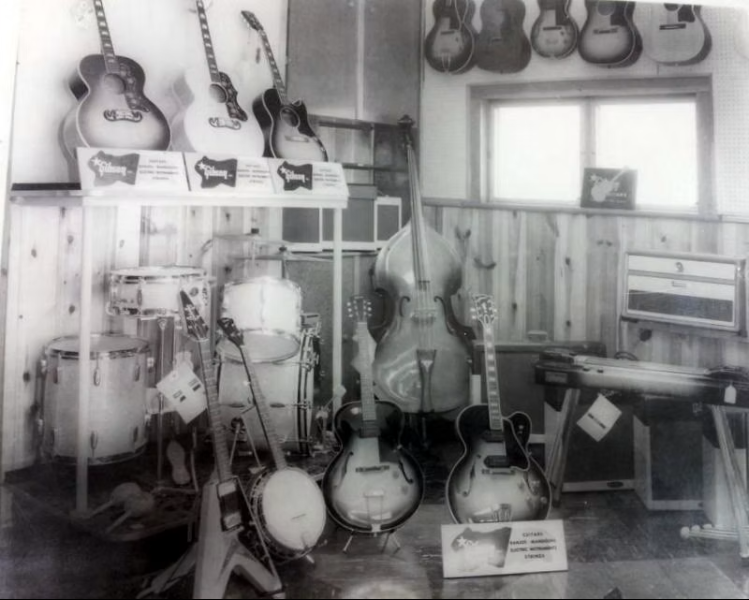
The Gibson Corner at Arthur’s Music Store, circa 1958, with the Flying V displayed at lower left among guitars, banjos, drums, and an upright bass.
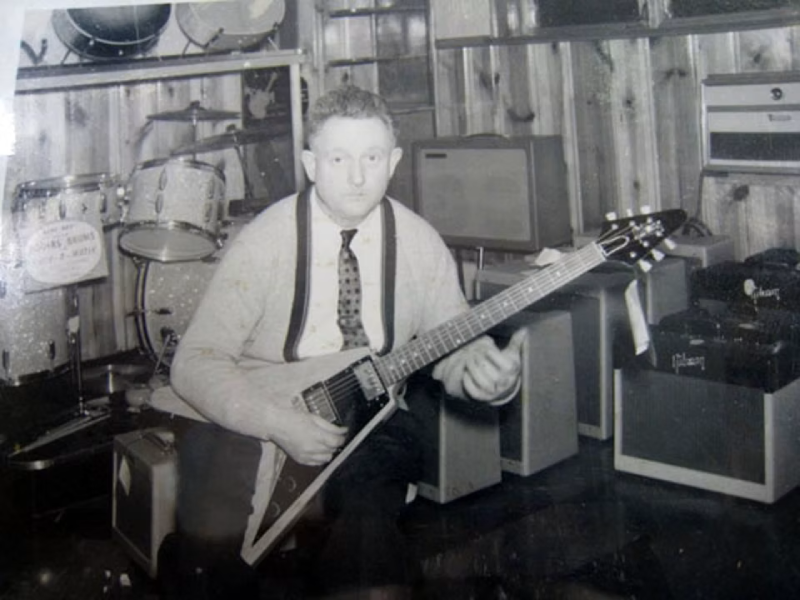
Amos Arthur poses with the 1958 Gibson Flying V at Arthur’s Music Store. Later acquired by Joe Bonamassa, the guitar became known as “Amos” in his honor.
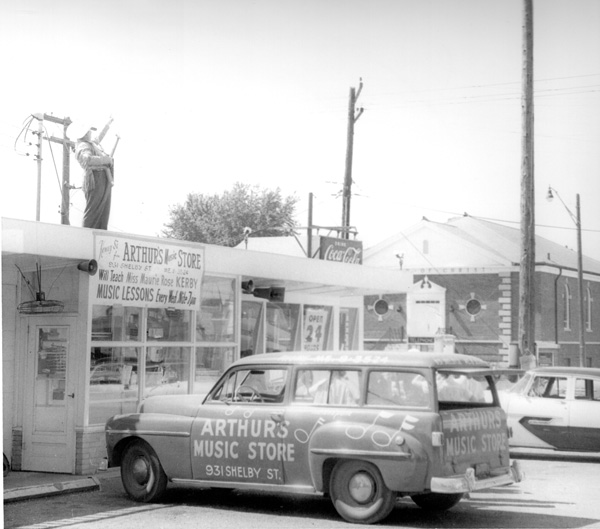
Arthur’s Music Store employee Kenny Si gives a rooftop guitar lesson to a pole-sitter using the 1958 Gibson Flying V later known as “Amos.” The store’s delivery vehicle is parked below.
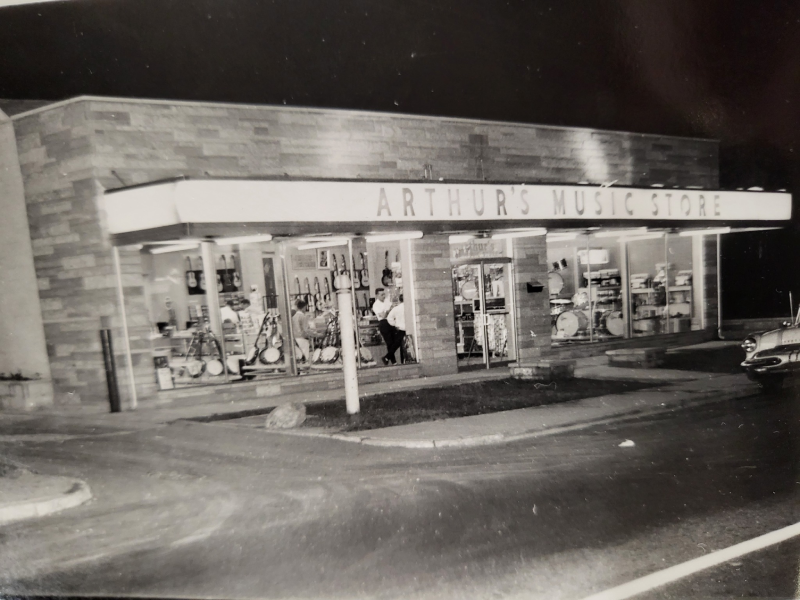
A nighttime view of Arthur’s Music Store at 931 Shelby Street in Indianapolis, likely from the late 1950s or 1960s, with illuminated display windows showcasing instruments.
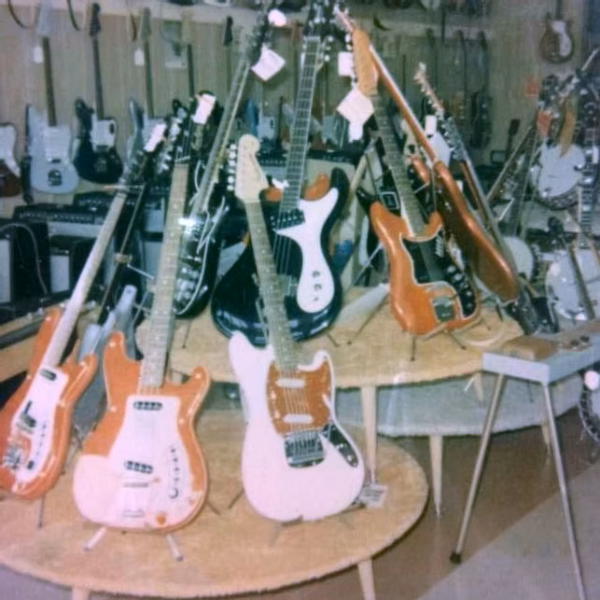
Arthur’s Music Store during the surf music era, with electric guitars and basses filling the showroom’s tables and walls.
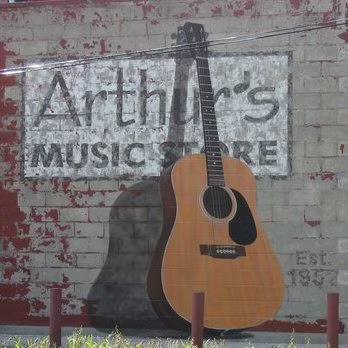
The north wall mural at Arthur’s Music Store in 2006, featuring a large painted acoustic guitar beside the store’s name.

Joe Bonamassa performs with “Amos,” the 1958 Gibson Flying V originally sold through Arthur’s Music Store in Indianapolis. Photo by Steve Rose.
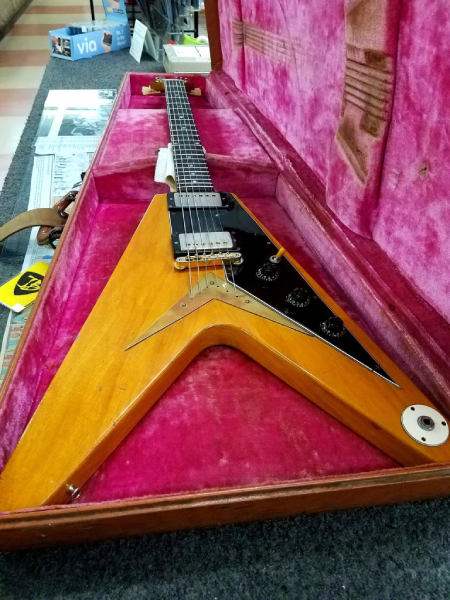
A close view of “Amos,” the original 1958 Gibson Flying V, resting in its pink-lined case, with its distinctive V-shaped body, black pickguard, and gold-colored tailpiece.
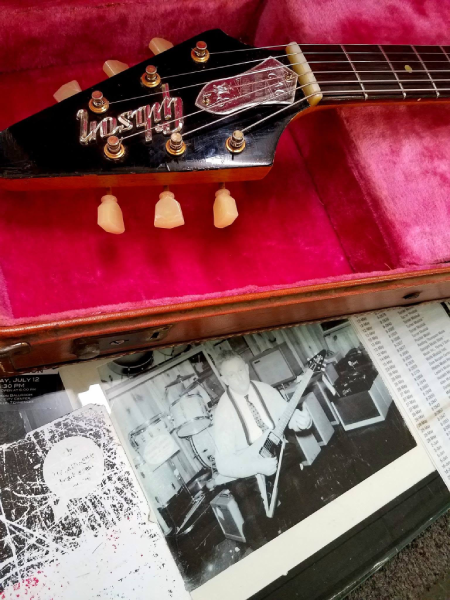
The headstock of the original 1958 Gibson Flying V known as “Amos,” displayed above a photograph of Amos Arthur holding the same guitar in 1958.
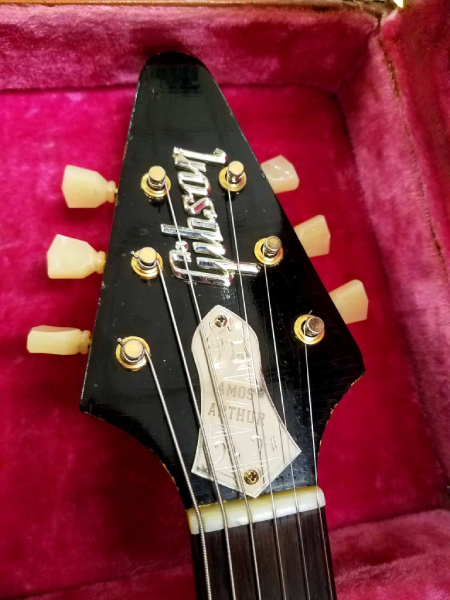
Headstock detail of “Amos,” the original 1958 Gibson Flying V, showing the Gibson logo and decorative truss rod cover bearing Amos Arthur’s name.

Steve Krider holds two generations of “Amos” at Arthur’s Music Store: the 2018 Epiphone Limited Edition Joe Bonamassa signature model at left and the original 1958 Gibson Flying V at right.
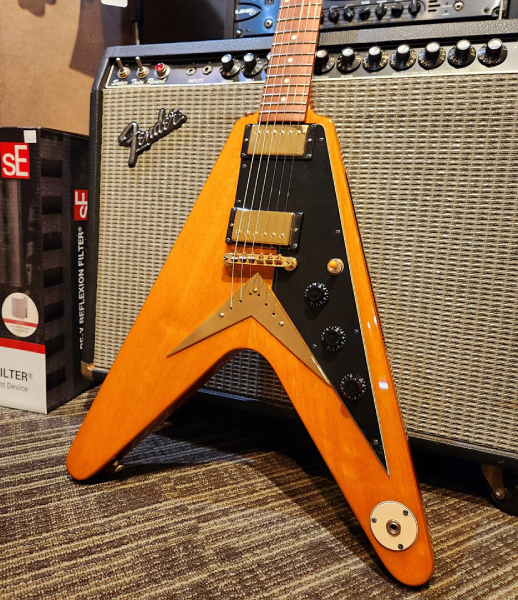
The Epiphone Limited Edition Joe Bonamassa “Amos” 1958 Flying V, a tribute to the original Gibson guitar sold through Arthur’s Music Store and later acquired by Bonamassa.
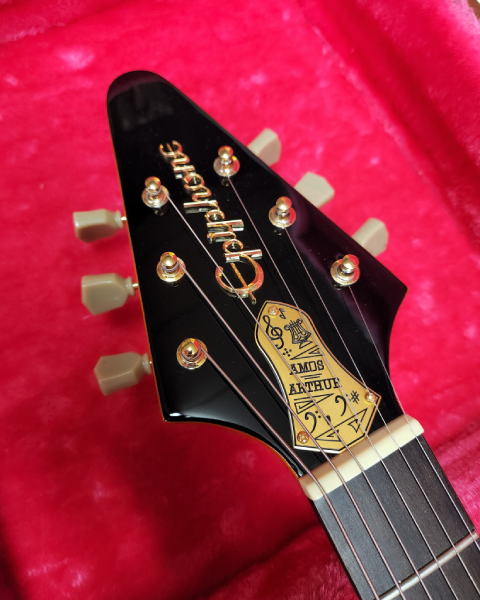
Headstock detail of the Epiphone Limited Edition Joe Bonamassa “Amos” 1958 Flying V, featuring a decorative truss rod cover honoring Amos Arthur.
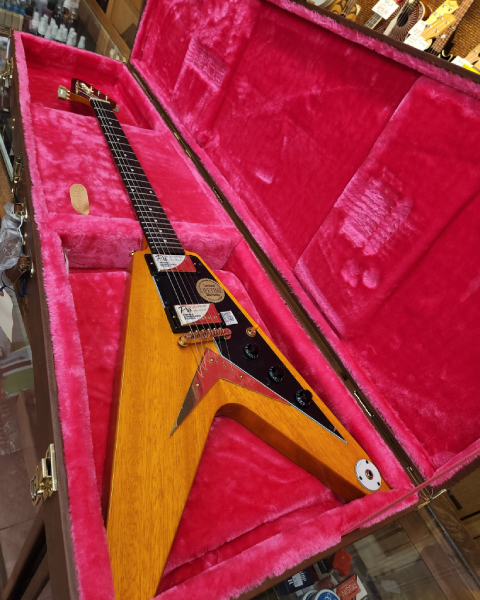
The Epiphone Limited Edition Joe Bonamassa “Amos” 1958 Flying V rests in its fitted, pink-lined case at Arthur’s Music Store.
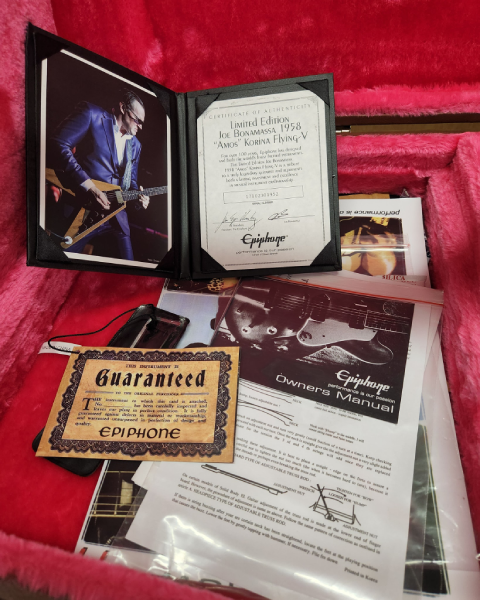
Certificate of authenticity, owner’s manual, and accompanying paperwork for the Epiphone Limited Edition Joe Bonamassa “Amos” 1958 Korina Flying V, displayed in its pink-lined case.
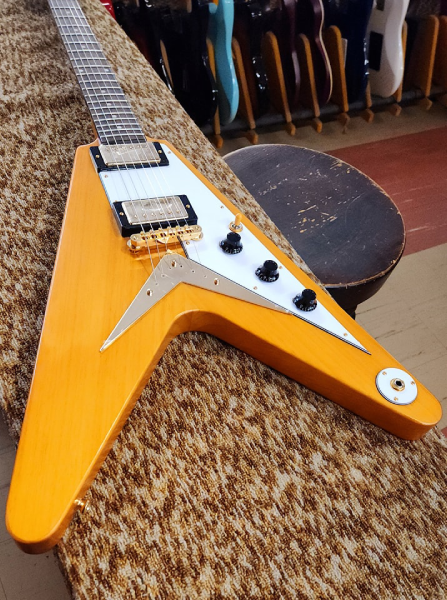
An Epiphone 1958 Korina Flying V at Arthur’s Music Store, featuring a natural wood finish, white pickguard, and gold-colored hardware.
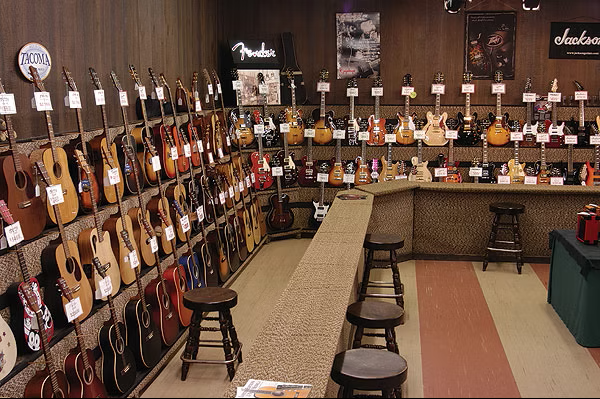
Arthur’s Music Store – The Famous Guitar Wall

A colorful display of new Epiphone guitars at Arthur’s Music Store. From left: ES-335, 1959 Les Paul Standard, 1958 Korina Flying V, Emperor Swingster, Miranda Lambert Bluebird, and Modern Figured Les Paul.
Preserving Indiana’s Music History
The Indiana Music History Project is made possible through the generous support of the Allen Whitehill Clowes Charitable Foundation. Their commitment to preserving Indiana’s rich musical heritage helps ensure these oral histories remain accessible for future generations.

Help Improve This Archive
Have additional information about this artist, story, or any of the photographs? If you can identify people, dates, locations, or have memories you’d like to share, we’d love to hear from you. Please use the button below and select “Submit Historical Information or Corrections” as the reason for your message.